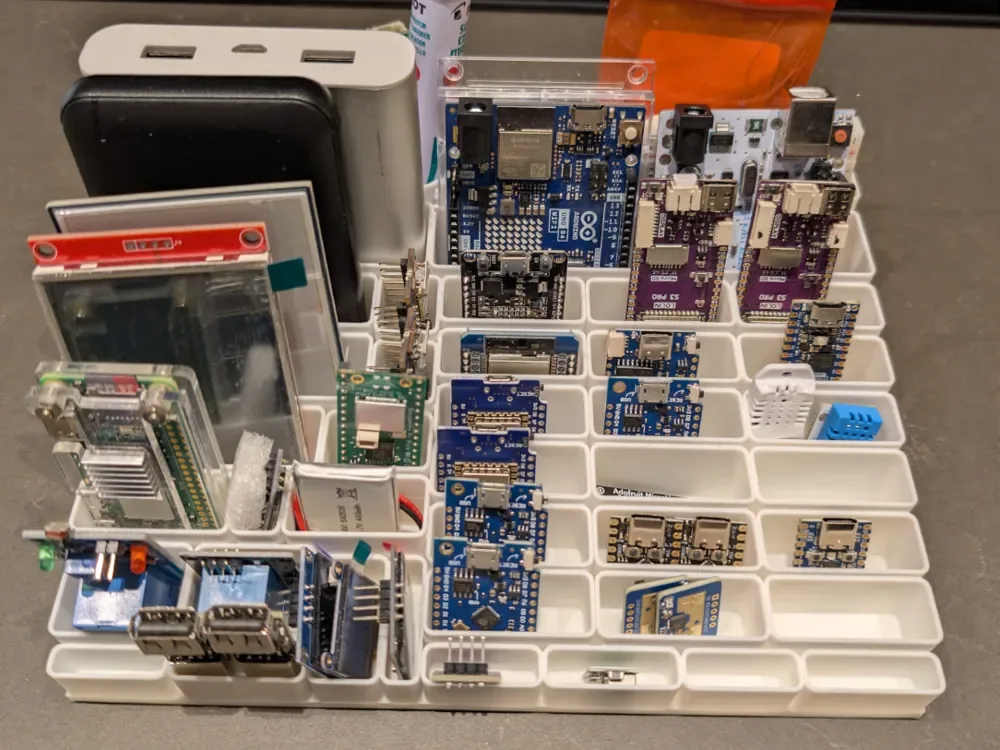
 Design reference photo
Creator photo; included parts are listed below. Accessories not included.
Development Board and Cell Organizer
3D printed in PETG for organizing loose microcontroller boards and project accessories.
Shipping within Canada is included in the listed price. Applicable taxes are calculated at checkout. Secure checkout for Canadian shipping addresses. Choose your quantity on Stripe. Shipping to the U.S.? Contact us for a shipping quote before ordering. U.S. shipping is an additional charge.
Check fit before ordering ↓A closer look
3D printed in PETG for organizing loose microcontroller boards and project accessories. Includes one printed development-board and cell organizer tray. Electronics, batteries, metal contacts, fasteners, accessories shown and installation are not included.
Check the fit
Start with these details so you can choose the right part for your setup.
- Confirm your board, connector or rack dimensions and mounting-hole pattern before ordering.
What’s included
- One printed development-board and cell organizer tray.
- Electronics, batteries, metal contacts, fasteners, accessories shown and installation are not included.
Give loose project parts a visible home
A development-board and cell organizer is useful when several small projects share the same bench. Arrange the tray around how you retrieve parts: a group for active boards, a group for spare modules, and a clear location for compatible cells or other project accessories where the tray geometry allows. Seeing the pieces together can make it easier to notice a missing board or an item that belongs to another build. Before loading the tray, remove clipped leads, packaging, and unidentified components from the work area. Keep project names or board references nearby so the organizer supports a repeatable setup instead of becoming a second place for miscellaneous parts.
Check boards with their attached components
The printed tray measures approximately 224.05 × 169.51 × 42 mm overall. Those dimensions help determine bench or drawer space, but they do not define the size of each compartment or the fit of every board. Measure the boards as stored, including header pins, sockets, attached adapters, and tall components. A board that fits by its bare outline may sit differently after headers are soldered on. Check that pieces can be picked up without catching neighbouring pins, and consider the full height of the loaded tray if it will go in a drawer. Compare cells separately and keep their terminals away from loose conductive parts.
Maintain a useful separation between storage and assembly
Use the tray to organize unpowered parts and keep active soldering, wire trimming, and loose hardware in a separate work area. This makes it easier to see the boards and reduces the chance of collecting conductive debris in the same compartments. Follow the handling requirements of your electronics; no antistatic protection is specified for the PETG tray. When moving the organizer, check that the contents are settled and remove awkward or unsecured pieces first. Brush the empty tray gently during cleanup and reassess the arrangement when a project ends. Returning surplus parts to their designated positions keeps the next project from starting with an unidentified pile of boards and cells.
Product questions
What does the listed price include?
One printed development-board and cell organizer tray. Shipping within Canada is included in the listed price. Applicable taxes are calculated at checkout. Electronics, batteries, metal contacts, fasteners, accessories shown and installation are not included.
Will this match everything shown in the photo?
The creator photo is a design reference and may show other variants, quantities or accessories. The included-parts list describes exactly what this listing supplies.
Can I assume the tray protects static-sensitive boards?
No antistatic or ESD-protective property is specified. Use handling and storage measures appropriate to the components you are organizing, and treat the tray as a physical arrangement aid.
Will populated boards fit like bare boards?
Not always. Headers, connectors, and tall components can alter both the required space and the way a board rests. Check the complete stored assembly against the compartment geometry.
Can I store loose screws beside cells?
Keep conductive loose parts away from cell terminals and follow the cells' storage instructions. Use a separate appropriate container for screws and clipped leads so the organizer stays easy to inspect and handle.
Original design: karzo.kalori — Dev Board Organizer: ESP32/Arduino/RPi + cells+acc. MakerWorld model 2325500. Original design